


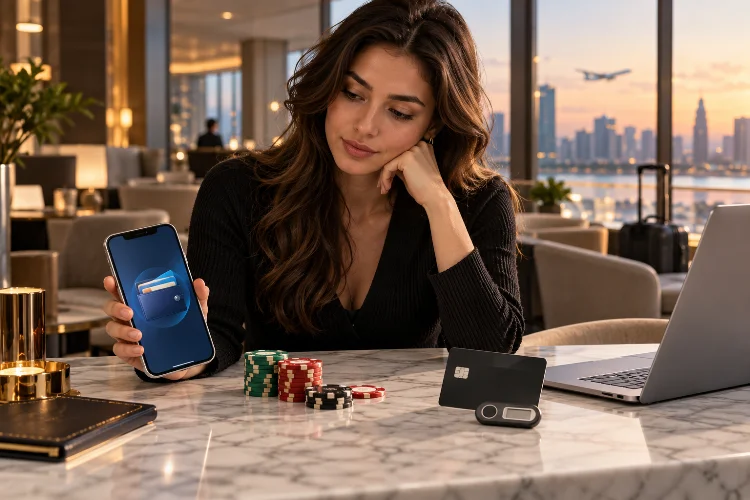
Choosing a casino game may take seconds, but choosing how to move money in and out of an account deserves more thought. E-wallets can feel fast and convenient, while bank transfers offer the familiarity of moving funds directly between financial accounts.
The debate around E-Wallets vs Bank Transfers for Online Casinos is not simply about which one is “better.” Processing time, fees, withdrawal support, privacy, regional availability, and verification can all affect the experience.
Looking at those factors separately makes it easier to choose a method that fits your priorities instead of selecting whatever appears first on the cashier page.
How E-Wallets Work at Online Casinos
An e-wallet is a digital payment account that can hold funds or connect to other payment methods.
Popular examples include PayPal and Skrill. The UK Gambling Commission describes e-wallets as services that can combine multiple payment methods and may be accepted by different gambling businesses.
The basic process is usually simple. You select the wallet at the casino cashier, log in to the payment service, approve the transaction, and return to the casino.
One advantage is that the casino may not need to receive your complete underlying bank or card information. PayPal, for example, states that payments are encrypted and that full financial information is not shared with merchants.
That extra layer between the casino and your bank can be appealing to players who prefer greater payment privacey.
How Bank Transfers Work
A bank transfer sends money directly from a bank account to another account or payment recipient.
Depending on the casino and country, this could involve traditional account details, local online banking systems, or newer instant-payment services.
Traditional bank transfers can sometimes take longer than wallet payments.
As a general payment-industry example, Wise says bank transfers used to fund its transfers can take roughly one to four working days, while timing can vary according to payment system, country, weekends, and bank processing.
That does not mean every casino bank transfer takes four days.
Some countries have real-time or near-real-time banking infrastructure, while international transfers may take considerably longer.
The important lesson is to check the estimated processing time shown by the casino rather than assuming every bank payment follows the same timetable.
Which Method Is Usually Faster?
Speed is one of the strongest arguments for e-wallets.
Digital wallets are designed for fast electronic payments. PayPal describes transfers between supported accounts as quick and secure, with some transactions reaching another account within minutes or even seconds depending on service and region.
Casino deposits made through an accepted e-wallet can therefore often be credited quickly once the payment is approved.
Bank transfers are more variable.
A domestic instant bank-payment system might complete very quickly, while traditional or international transfers can require one or more business days.
Withdrawals add another variable because the casino may need to approve the request before the payment provider or bank receives it.
So the fastest deposit method does not automatically produce the fastest withdrawal.
Fees Can Change the Comparison
A payment method that looks free at first can still involve costs somewhere in the transaction.
E-wallet providers may charge fees for certain funding methods, withdrawals, or currency conversions. PayPal, for example, notes that fees can apply when converting currencies or making some international transactions.
Skrill also distinguishes between different funding sources and can apply rules based on how wallet funds are deposited and used.
Bank transfers may also involve charges, especially with international or SWIFT payments.
There are three possible places to check: the casino, the payment provider, and your bank.
A casino might charge nothing while your wallet provider applies a conversion fee. Alternatively, the casino may impose a processing cost on a particular withdrawal method.
The cheapest choice therefore depends on the full trasnaction, not simply the payment button you click.
What About Security and Financial Privacy?
Both methods can be secure when used with reputable providers.
E-wallets can reduce how often your underlying financial details are shared with individual merchants. PayPal says its transactions are encrypted and that merchants do not receive customers’ complete financial information.
Bank transfers remove the need for an additional wallet account but connect the casino payment more directly to your banking relationship.
Neither approach eliminates fraud or account-security risks.
Strong passwords, multi-factor authentication, correct account details, and using licensed gambling operators remain important.
Regulated operators may also restrict third-party payment methods. The UK Gambling Commission has warned that gambling accounts funded through payment methods belonging to someone else can create fraud and verification concerns.
In practical terms, use payment accounts registered in your own name.
Withdrawal Convenience Can Be Different
Deposits are only half the payment experience.
Before choosing a funding method, check whether the same option is available for withdrawals.
Some casinos may support an e-wallet for both directions, making it easy to receive winnings into the same wallet used for the deposit.
Bank transfers are commonly suitable for withdrawals too, especially where alternative methods cannot receive funds.
However, regulated operators can still conduct legitimate identity or anti-money-laundering checks.
In Great Britain, players generally have the right to withdraw their deposit balance without unreasonable restrictions, although necessary regulatory checks and clearly disclosed cost-based processing fees can still apply.
A pending verification request can therefore matter more than whether you selected a wallet or bank.
Regional Rules Can Affect E-Wallet Availability
Payment options are not universal.
A wallet available at one casino may disappear in another country because providers, operators, and regulators apply different rules.
Great Britain provides a good example. Gambling operators cannot accept credit-card gambling payments, including situations where credit-card funds are routed through certain e-wallets.
That means an e-wallet does not automatically bypass local payment restrictions.
The casino must also use qualifying payment-service providers under applicable licensing requirements.
Players should therefore treat payment availabilty as market-specific rather than assuming PayPal, Skrill, or bank transfer works everywhere.
Which Option Makes More Sense?
E-wallets can be attractive when speed, convenience, and keeping merchant access separate from underlying financial details are priorities.
Bank transfers may suit players who prefer moving funds directly from a familiar banking account and do not want to maintain an extra digital wallet.
Neither option guarantees faster casino approval or avoids verification.
Before paying, compare deposit time, expected withdrawal time, minimum and maximum amounts, fees, supported currencies, and whether the method works in both directions.
Also make sure you are comfortable with the gambling amount before transferring it. Payment convenience should never become a reason to deposit more frequently than planned.
E-Wallets vs Bank Transfers for Online Casinos comes down to personal priorities. E-wallets often emphasize speed and convenience, while bank transfers offer a direct connection to traditional banking.
Neither is universally superior. Check fees, processing times, withdrawal availability, verification rules, and regional restrictions before choosing, and use only payment accounts registered in your own name and within a predetermined gambling budget.
